

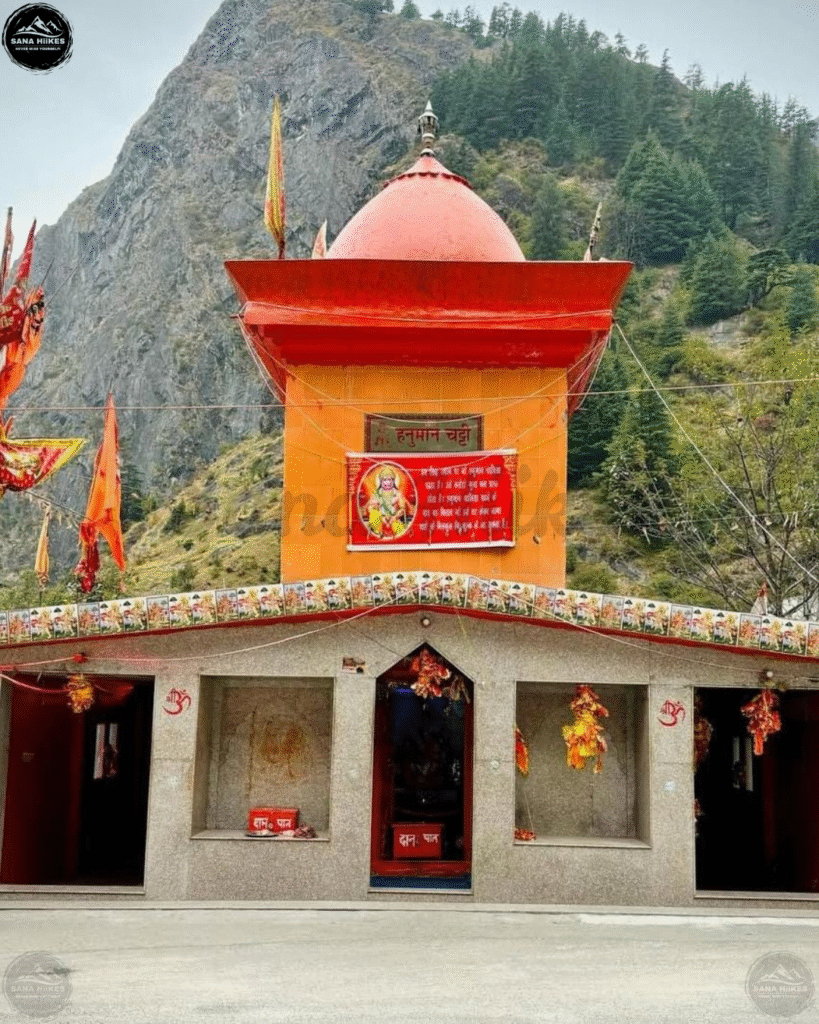
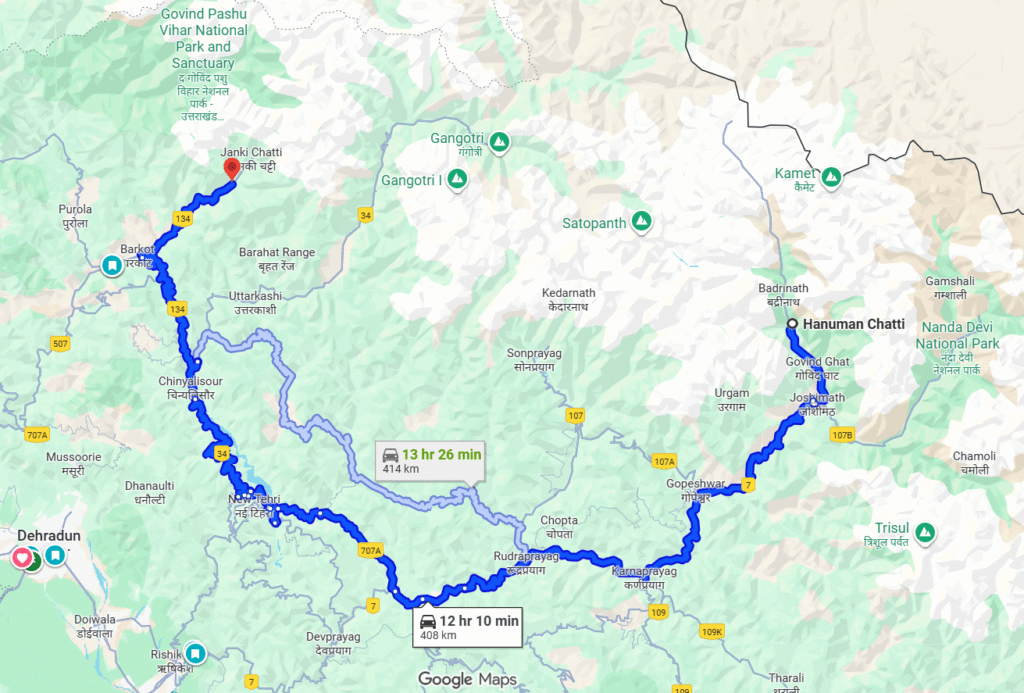
Hanuman Chatti, the place where “Lord Hanuman humbled Bheem’s ego”. But you know what I have found after digging a little deeper? There are actually two Hanumna Chattis in Uttarakhand! The locals are well aware of this, but for travellers like us, it often creates confusion. As it has the same name and a similar temple structure but is in two completely different locations that are 408 km apart from each other. The word ‘Chatti’ is derived from ‘Chattiya’, which in local Garhwali (the language of Uttarakhand) and in Hindi means a small village or the resting place on a route. Both the temples stand out with their vibrant saffron walls and a bright orange dome. With the radiating divine warmth against the crisp mountain air. Apart from the name and faith, the breathtaking backdrop of the Himalayas ties them together.
The Hanuman Chatti on the way to Yanumotri Dham sits beautifully at the confluence of the Hanuman Ganga and Yamuna rivers. With an elevation of about 2,400 metres, this serene place lies 13 km before the Yamunotri Dham in the Uttarkashi district of Uttarakhand. This place is surrounded by the calm mountains and whispering rivers. Hanuman Chatti also offers a peaceful pause for the pilgrims heading to Yamunotri. Beyond its spiritual charm, Hanuman Chatti also serves as the trekking base for several treks, including Gulabi Kantha, Darwa Top and Dodital. This makes it a perfect blend of devotion and adventure in the lap of the Himalayas.
The other Hanuman Chatti lies along the Badrinath route just after Pandukeshwar. This is situated about 11 km before reaching Badrinath on the main highway. This Hanuman Chatties is said to be deeply associated with the mythological connection. It is believed to be the very place where Lord Hanuman humbled Bheem’s ego during the time of the Mahabharata. This place stands as a reminder that even the strongest must bow before humility and wisdom.
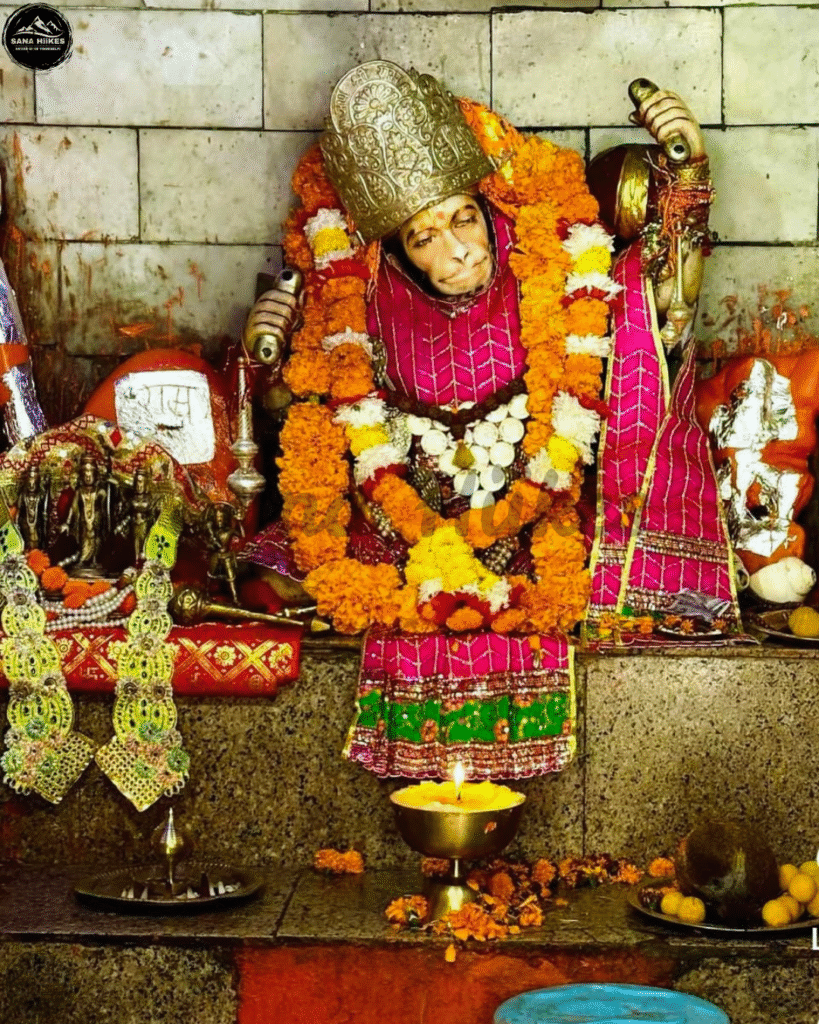
History of Hanuman Chatti
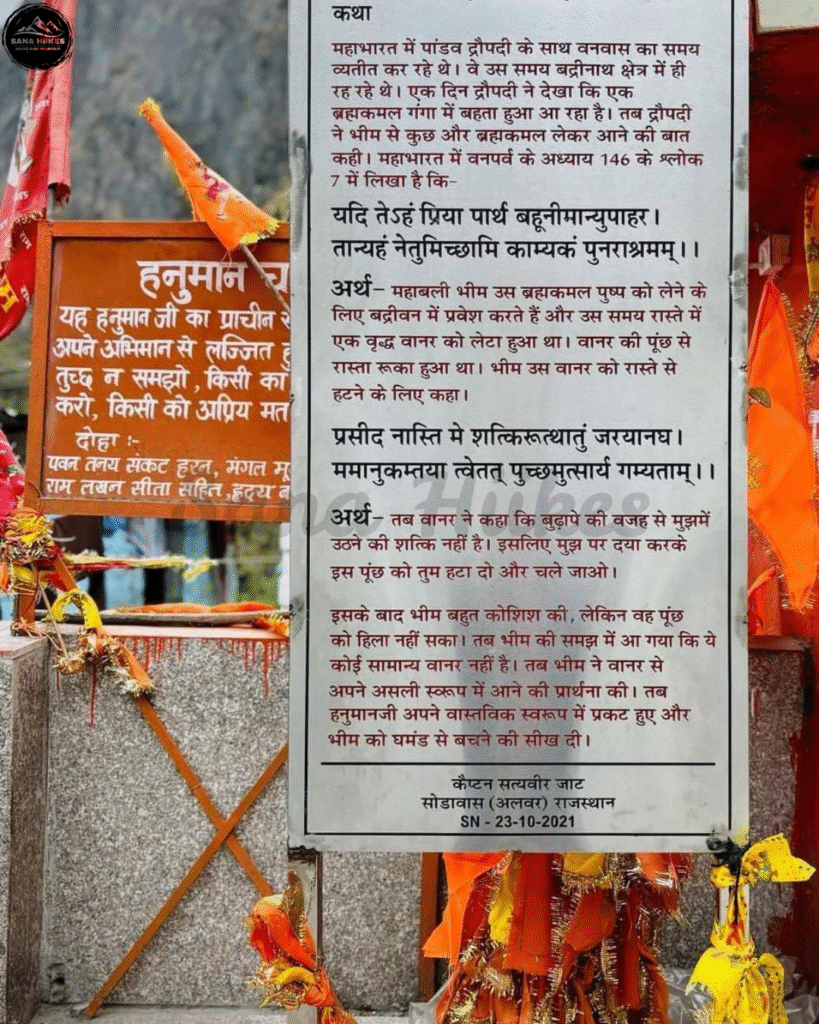
According to local folklore and mythology, Hanuman Chatti holds a connection to Hanuman and Bheem. The story takes us back to the time when the Pandavas were living in exile. One day, as they were crossing through the forest, Draupadi saw a beautiful Brahmakamal, a divine flower floating on the Ganga. With the captivating beauty and heavenly fragrance of the rare flower, she asked Bheem to bring her more of those flowers. Bheem was always eager to fulfil every wish of his beloved wife and set out on a quest in search of Brahmakamal. He went on searching for longer hours, crossing rivers and wandering in the dense forest but the elusive flowers were nowhere to be found. Restless and frustrated, he kept searching and eventually reached Gandhamadana Peak. But as he couldn’t find the flower, his pride and anger began to take over him.
Bheem started destroying and killing several animals on his way with his arrogance and fury. By seeing this, Lord Hanuman decided it was the time to humble his mighty brother and teach him a lesson about strength and pride. And this is where the story begins of Hanuman Chatti, the place where ego met devotion and strength bowed before wisdom. As Bheem continued his search, he suddenly came across an old monkey lying on the side of the path. The long tail stretched right across the road, blocking his way. Bheem arrived, already tired and frustrated, and called out to the old monkey, asking him to move aside. But the old monkey didn’t even flinch and said softly, “I’m too old and weak to move.” He then continued saying, ‘If you are in a hurry, why don’t you just step over me or move my tail by yourself?’
Read other Blog about: Pandukeshwar
Bheem’s temper flared. How could a warrior like him be stopped by an old monkey? He felt insulted and decided to teach the creature a lesson. He bent down, grabbed the monkey’s tail and tried to push it aside. But to his surprise, he couldn’t move an inch. Confused, Bheem tried again, this time putting all his immense strength into it, but it was still the same. Now, for the first time, Bheem felt powerless. It just looked like a simple tail, light and harmless but it weighed more than a mountain. Bheem breathlessly stared at the old monkey, realising that there was something divine about him. With shame in his eyes and pride shattered, humiliated Bheem finally realised that he was not dealing with an ordinary monkey. He bent down with folded hands, he humbly asked the old monkey to reveal his true identity.
The monkey simply smiled with a calm knowing and in an instant his true form began to change. After Lord Hanuman revealed his real face, Bheem realised that the old monkey was Hanuman, his elder brother. He bowed down before Hanuman, realising how his ego had blinded him. Bheem soon realised his mistake and begged him for forgiveness. Hanuman gently blessed him and guided him with the instruction on how he can reach Kubera’s garden. Where he could find the rare Brahmakamal flowers he was searching for. His pride gone and heart filled with devotion, Bheem set off again. And this time, he was not only carrying the bouquet of flowers but also a lesson in humility from his divine brother, Lord Hanuman.
According to another legend, It is also believed that Lord Hanuman once meditated here. He devoted himself to pleasing Lord Vishnu in Badrinah. The place not only witnessed the deep penance and unwavering devotion. But also it makes it a symbol of faith, humility and divine connection with mythological significance.
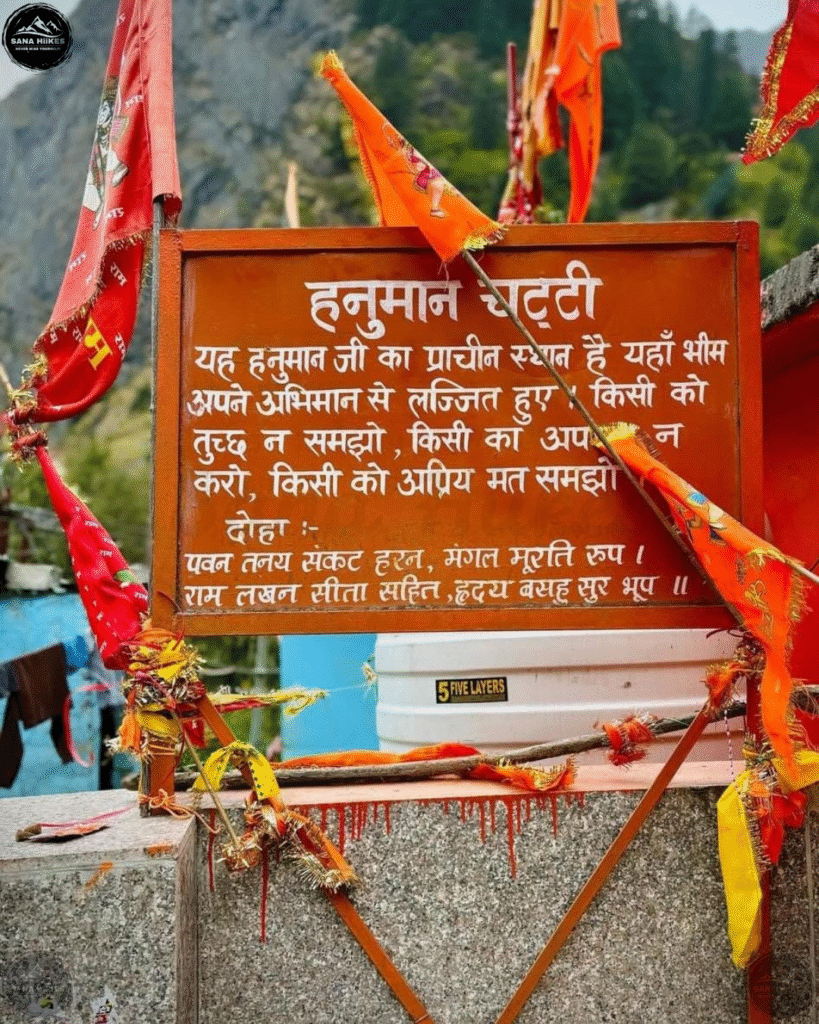
Facts about Hanuman Chatti
- The story about Hanuman Chatti, where Lord Hanuman humbled Bheem’s ego, is rooted more in the oral tradition and regional folk stories than in documented history. These traditions have been passed down through generations by the locals and pilgrims. The sources conflate with the local folk stories, blending myth, faith, and geography.
- Since there is no explicit quote from the Mahabharata that names Hanuman Chatti near Badrinath as the place. But in the Vana Parva, where it describes Bheem’s encounter with Hanuman, the mighty Pandavan learns a lesson in humility. Also, it does not specify that Hanuman Chatti near Badrinath is the exact location for the historical incident.
- Lastly, over time such legends have evolved and travelled with the people who tell them. These stories have shifted with time, as the temple is seen as a symbolic site where devotees associate the spirit of the story. Still, it has led to a common confusion between the two Hanuman Chattis, one near the Yamunotri and the other near the Badrinath. Both share the same name and are deeply revered stops for pilgrims.
Best Time to Visit
You don’t really need to wait for the perfect time to visit Hanuman Chatti. You can visit the temple on the way to Yamunotri and Badrinath, which fall right along the route. Anyone travelling to either Dham can easily take a short halt. Though the temple remains open throughout the year, the monsoon season can be very risky. Landslides are very common, and the roads often stay blocked for longer times, which makes travel unpredictable.
During the winter, this region gets covered with the snow blanket. This turns the scenery into the white landscape. As the temple remains open, the road leading to the temple is mostly closed due to heavy snowfall.
How to Reach Hanuman Chatti?
You can easily reach Hanuman Chatti by road, whether you are heading towards Yamunotri or Badrinath. Both routes are well-connected by buses and shared taxis from Rishikesh. As there is no airport or railway station nearby, you have to reach Rishikesh first, which is the best option if you are flying or coming by train.
Hanuman Chatti (near Yamunotri): You will find this stop on your way to Yamunotri. Also, many travelers take a short break before starting their trek towards the Dham.
Hanuman Chatti (near Badrinath): This place is on the route to Badrinath, where you can make a quick visit while en route.
Leave a Reply